




How blunt knives are quietly costing your business money
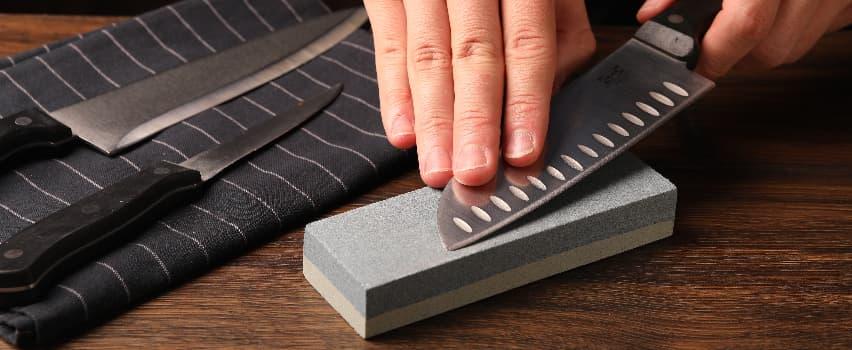
As one of the most important tools in any professional’s kit, there’s no denying how much you depend on your butcher's knives throughout the working day. From trimming joints to deboning fish, reliable knives are essential, keeping even the most tricky, delicate work efficient and precise.
But while most professionals understand how crucial it is to invest in quality blades, maintenance tools like knife sharpening stones are often overlooked. Over the last three decades, we’ve spoken to a lot of customers who are unsure about knife maintenance, asking questions like ‘what sharpening stones do I need?’ or ‘how often should you sharpen knives?’ It’s understandable – there are plenty of misconceptions around knife maintenance, and in a busy working environment, it can easily fall to the wayside, quietly costing you money over time. With that in mind, let’s take a closer look at why maintaining sharp knives matters so much, and how sharpening stones can help protect both your tools and your business.
Extending preparation time and reducing efficiency
Whether you’re trimming meat, slicing joints or working around bones, a sharp knife helps you move cleanly through products with accuracy and consistency. A blunt blade, on the other hand, can drag and tear rather than slicing neatly, making preparation much harder. Tasks that should feel smooth and controlled suddenly require extra pressure, repeated cuts and more physical effort from the user – and over the course of a working day, that loss of efficiency quickly adds up and impacts your operating costs.
Increasing waste through poor cutting performance
Knife sharpness doesn’t just affect efficiency – it also has a direct impact on precision. When your knives struggle to cut cleanly, it becomes far more difficult to produce accurate portions and neat trims. This can lead to unnecessary waste, which can be especially costly when working with expensive cuts of meat.
For example, a sharp boning knife allows you to follow the contours of the bone closely, helping maximise yield while keeping cuts tidy and controlled. A dull blade makes that same task far more awkward, increasing the chance of leaving usable meat behind or damaging the product during preparation.
Consistency also matters when serving customers. Uneven slices, ragged cuts and poorly presented products can affect the overall appearance of your display, especially in customer-facing environments like butcher counters and farm shops. Over time, this can damage your reputation and deter customers from returning or choosing your products again.
Shortening the lifespan of your equipment
One of the less obvious ways blunt knives can cost your business money is through reduced tool lifespan. When knives are properly maintained with regular sharpening, they tend to stay in serviceable condition for far longer, simply because the blade is being cared for in the right way throughout its use.
A well-maintained edge ensures cleaner, more controlled cutting, which helps reduce unnecessary strain on the blade itself. In contrast, continuing to use a dull knife often leads to more aggressive force being applied during preparation, which can contribute to faster wear and a greater likelihood of edge damage over time. Regular sharpening also helps avoid the need for more intensive restoration work further down the line, where more material has to be removed to bring a blade back into shape. Over time, that difference in maintenance approach can have a major impact on how often your knives need replacing and the overall cost of keeping your kit in good working order.
Choosing the right sharpening stone for your knives
So, if you’re ready to improve your maintenance routine and are wondering, ‘What sharpening stones do I need?’, let’s break it down. The answer largely depends on the condition of your knives, the type of edge you want to achieve and how frequently your blades are used. Coarser grit stones are ideal for restoring dull or damaged blades, working more efficiently to help re-establish the edge. Medium grit stones are well-suited to routine sharpening and maintaining consistent everyday performance, while finer grit stones are used to refine and polish the blade for a smooth, precise finish. In practice, many professionals find that using a combination of grit levels within their sharpening routine helps maintain a consistent, reliable edge throughout daily use.
How to use a sharpening stone properly
Before sharpening, it’s important to prepare the stone correctly. Some stones require water while others use honing oil, depending on the material and the manufacturer’s instructions. Keeping the surface lubricated helps to reduce friction and allows the blade to glide smoothly during sharpening. The knife should then be held at a consistent angle against the stone, usually somewhere between 15 and 20 degrees, depending on the blade. Keep your movements steady and controlled, holding a consistent angle as the blade passes over the stone.
After a few passes on one side, you’ll usually start to feel a light burr form along the edge. This is a very fine raised edge of metal on the opposite side, and it’s a good sign that you’ve worked the blade evenly right up to the cutting edge. Once that burr can be felt along the length of the blade, you can flip it over and repeat the same process on the other side. The aim is to gradually refine and remove the burr altogether, leaving a clean, stable edge that will perform consistently. Remember: start with a low grit and gradually move up to a high grit.
Those are the essentials covered! If you’re looking for knife sharpening stones to help you avoid the hidden costs that come with inefficient cutting, we’ve got a range of options for you. With over 30 years of experience to our name, excellent Trustpilot ratings and an industry-leading reputation for excellence, we’re proud to supply professional-grade tools that hardworking butchers and catering businesses can depend on every day, including machinery like meat slicers, bandsaws and mincers.
With leading brands like F. Dick, Taylor's Eye Witness and Norton Saint Gobain available with speedy delivery, it’s easier than you might think to find premium, competitively priced equipment for your work. Still thinking, ‘What sharpening stones do I need?’ Give us a call on 01254 427 761 today, and our friendly team will be happy to help.